
Latest News
Stay updated with insights from ArborESG Tech
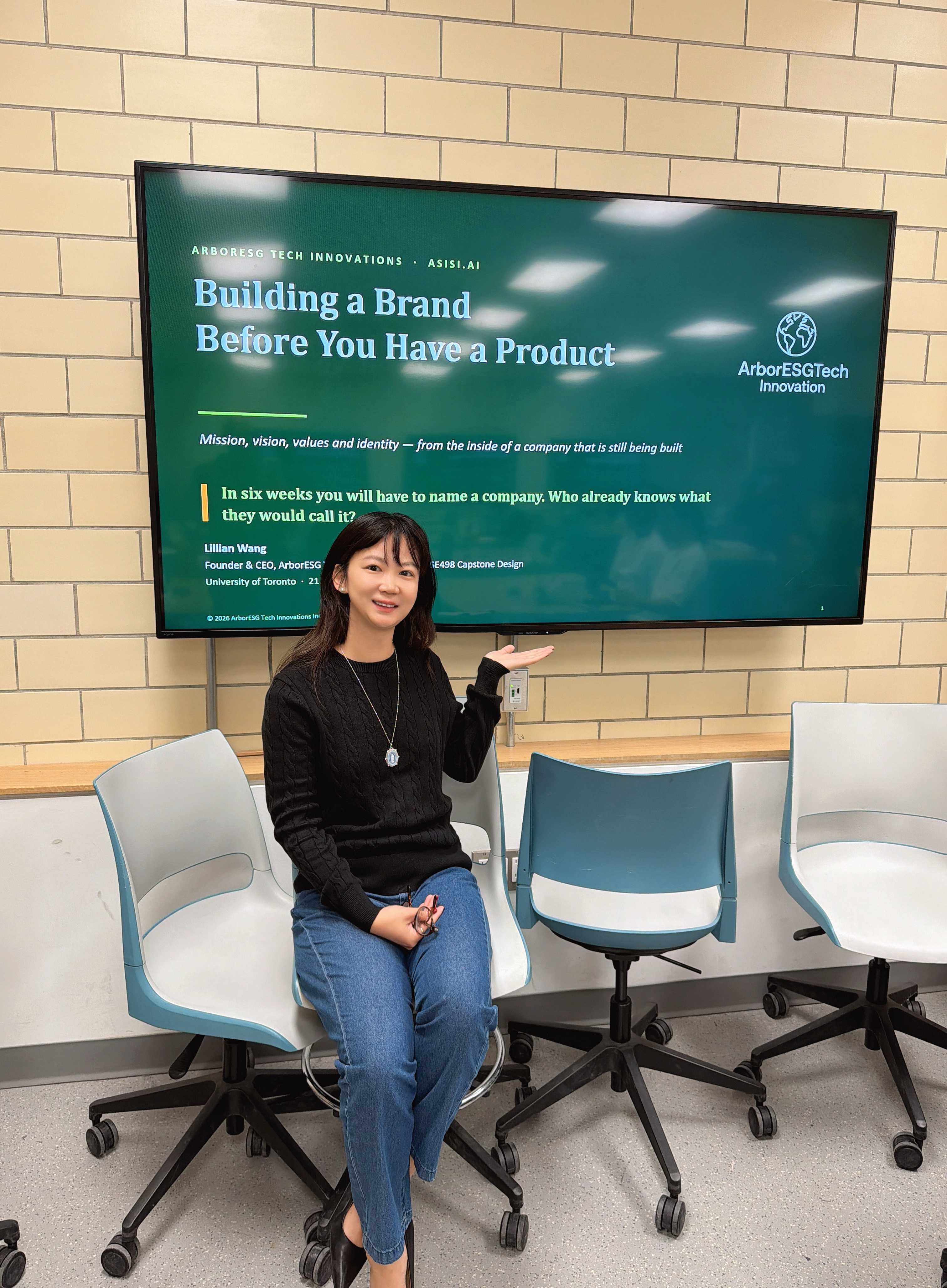
Founder and CEO Lillian Wang delivered a guest lecture on entrepreneurship to fourth-year engineering students at the University of Toronto.
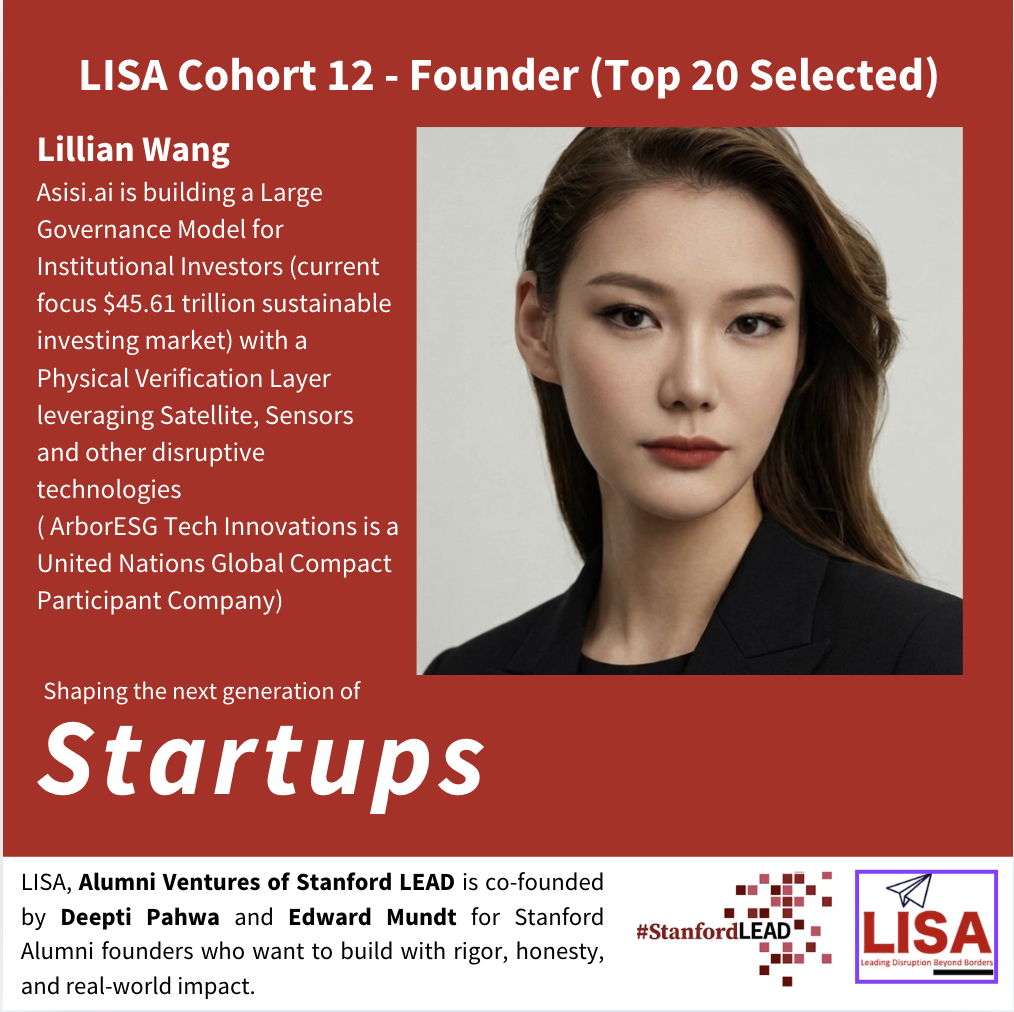
Lillian Wang and Asisi.ai were recognized in LISA Cohort 12 as a founder selected in the top 20, highlighting work on a large governance model for institutional investors and sustainable innovation.
We are proud to announce ArborESGTech's official participation in the United Nations Global Compact, committing to the Ten Principles on human rights, labour, environment, and anti-corruption.

Former Managing Director of Quantitative Strategy at CPP Investments and Former Vice President at BlackRock joins ArborESGTech as an Advisor.
CEO Lillian Wang attended AI @ Work: The Executive Forum for Frontline Workforce Innovation at Stanford GSB.
CEO Lillian Wang attended the Future of Mathematics Symposium at Stanford University.
CEO Lillian Wang attended 'Powering Global Cooperation: Innovation, Security, & Geopolitics in a Changing Energy Landscape' at the Hoover Institution.
CEO Lillian Wang attended the AI + Science at Stanford Institute for Human-Centered Artificial Intelligence (HAI) and Stanford Data Science to explore collaboration opportunities with leading AI and data scientists.
CEO Lillian Wang attended 'The Declaration of Independence at 250: Is the Declaration Our Law?' at Stanford Law School.
CEO Lillian Wang participated in Stanford University Graduate School of Business seminar on Sustainable and Responsible Operations in the Age of AI, co-hosted with the Stanford Doerr School of Sustainability.
We're excited to announce that asisi.ai has been selected for the 1 in 20 cohort at LISA (Leadership, Integrity, Sustainability, Accountability) at Stanford Graduate School of Business LEAD Incubator & Startup Accelerator.
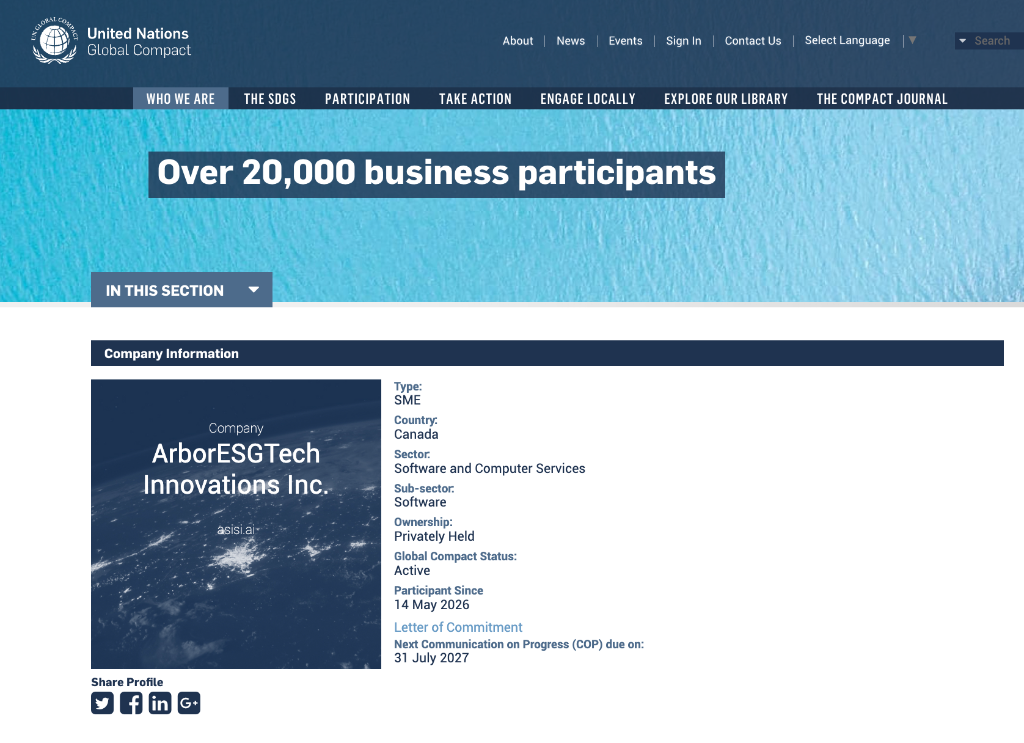
ArborESGTech officially joins the United Nations Global Compact — the world's largest corporate sustainability initiative with 25,000+ participants across 160+ countries.

The race for AI computing supremacy intensifies as NVIDIA, AMD, and tech giants developing custom chips compete for dominance in the rapidly expanding AI hardware market.

Businesses are realizing substantial ROI from generative AI implementations, with early adopters reporting 30-50% efficiency gains across operations. Strategic implementation approaches drive success.

Artificial intelligence is revolutionizing healthcare delivery with breakthrough applications in diagnostics, drug discovery, and personalized medicine, improving patient outcomes and operational efficiency.

The European Union's landmark AI Act establishes the world's first comprehensive regulatory framework for artificial intelligence, setting standards that will influence global AI development.

OpenAI has launched GPT-4 Turbo with enhanced capabilities, lower costs, and extended context windows. This breakthrough is transforming how businesses leverage AI technology.
A look at the most promising research directions in artificial intelligence.
Exploring the latest innovations in transformer models and their implications.
Comprehensive framework for evaluating AI startup investments.
A comprehensive guide to AI alignment and its implications for society.
How Environmental, Social, and Governance principles are shaping AI development.
Company expands mission to bring responsible AI practices to enterprises worldwide.
Building a balanced AI investment portfolio across stages and sectors.
Understanding how we measure AI capabilities and the limitations of current benchmarks.
New frameworks for assessing the value of AI-driven businesses.
Examining the role of open source in AI development and its implications.
How artificial intelligence is accelerating the development of new medicines.
Everything startups need to know to successfully raise their Series A round.
Best practices for fostering strong team culture in distributed AI organizations.
An overview of specialized hardware accelerating AI development.
A guide to metrics and frameworks for assessing ESG performance in tech.
Practical insights from deploying AI systems in real-world production environments.
Understanding the emerging landscape of autonomous AI agents and their capabilities.
An overview of emerging AI safety regulations across different jurisdictions.
Adapting governance structures to address AI-specific risks and opportunities.
Exploring the intersection of quantum computing and artificial intelligence.
How AI can be designed to benefit all of society, not just the privileged few.
How AI is being used to design better AI systems through automated architecture search.
How user-centered design principles contribute to safer AI systems.
Analysis of current venture capital trends in AI and what they mean for startups.
Strategies for making AI development more environmentally sustainable.
Comparing exit options for AI companies and factors that influence the choice.
How edge computing is revolutionizing AI deployment on local devices.
Exploring how AI safety has transformed from academic discourse to real-world implementation across industries.